The Henkelion carrier has been under an airplane seat more times than I can count. I bought one for Biscuit before a Colorado trip in the spring of 2023, and it has now flown on Southwest, Delta, and American with my two Yorkshire Terriers. Biscuit is a nine-year-old six-pound boy. Poppy is five and eight pounds. I live in Round Rock, Texas. I pack the carrier the same way every time: clip the pad in, loop the safety tether to a harness, and slide it under the seat in front of me. That routine has survived forty trips, and the Henkelion has not needed one repair.
I did not start with the Henkelion. I started with a prettier bag that was advertised as airline approved and then tilted under a Delta seat. The zipper caught Biscuit's fur every time I opened it. That bag cost me a rushed checkpoint and a scratched hand, so I threw it into a donation bin outside Austin. This is the long-term review I wanted before I bought the fancy one.
The Quick Verdict
After 40 flights and road trips, the Henkelion is the first carrier I trust for both dogs, provided you add a real pad and always clip the tether.
Amazon Check Today's Price →The one carrier I kept after the prettier bag failed
I bought this with my own money in 2023 and I would buy it again for Biscuit and Poppy. If you fly with a small dog, this is the one to measure under the seat before you book.
Amazon Check Today's Price on Amazon →How I've Used It
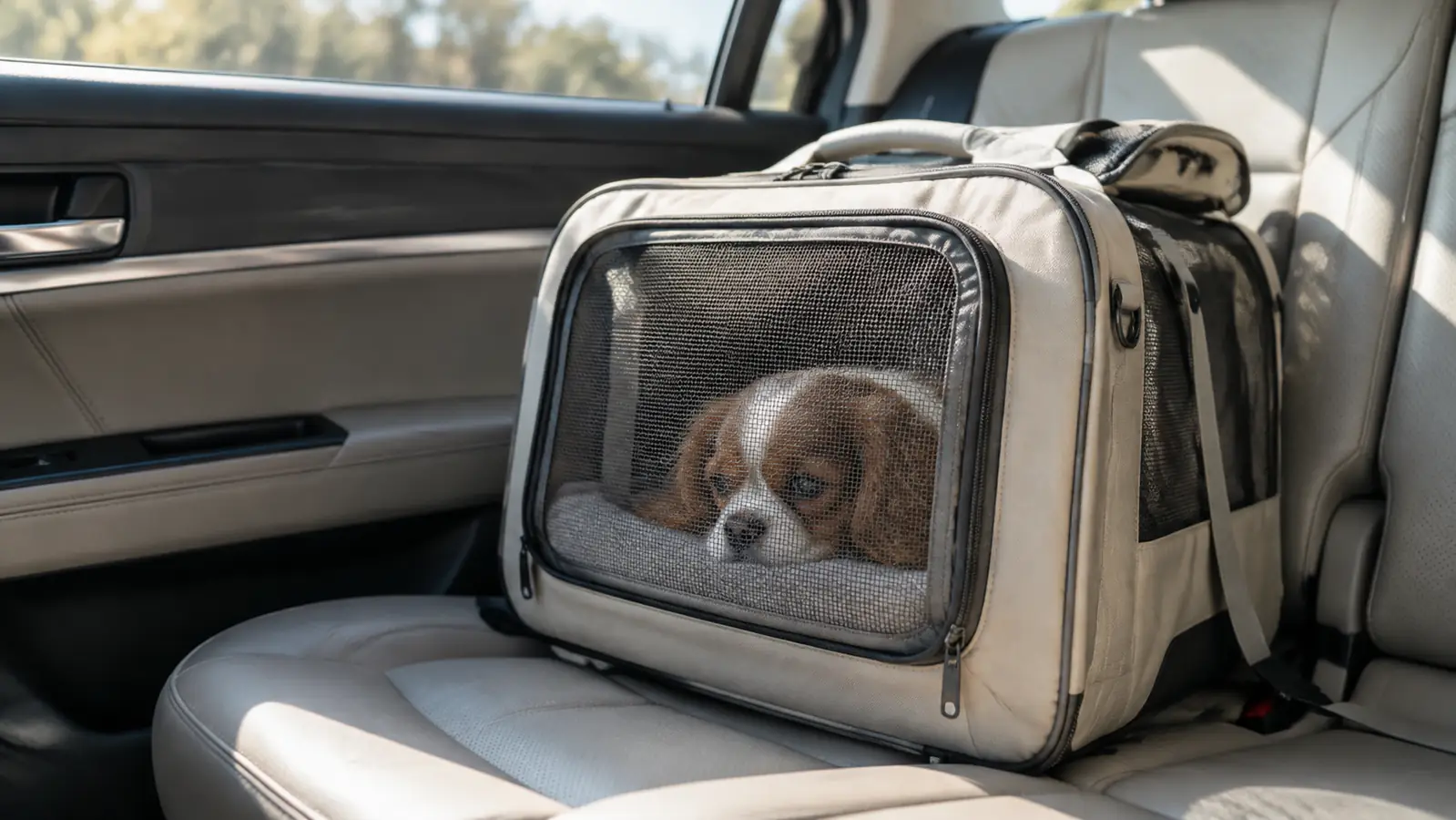
Most of our travel is road trips in a 2019 Honda CR-V. The carrier sits in the back seat with the seatbelt threaded through the handle. Biscuit can make eye contact with me in the rearview mirror, and that settles him. Poppy needs the tether clipped to her harness, or she will nose the netting and try to climb over the flap. The first road trip with this carrier, I forgot the tether at a rest stop in New Mexico. When I unzipped the top to hand Poppy water, she lunged and got her shoulders out before I grabbed her collar. She did not get far, and that was the last time I ever skipped the tether.
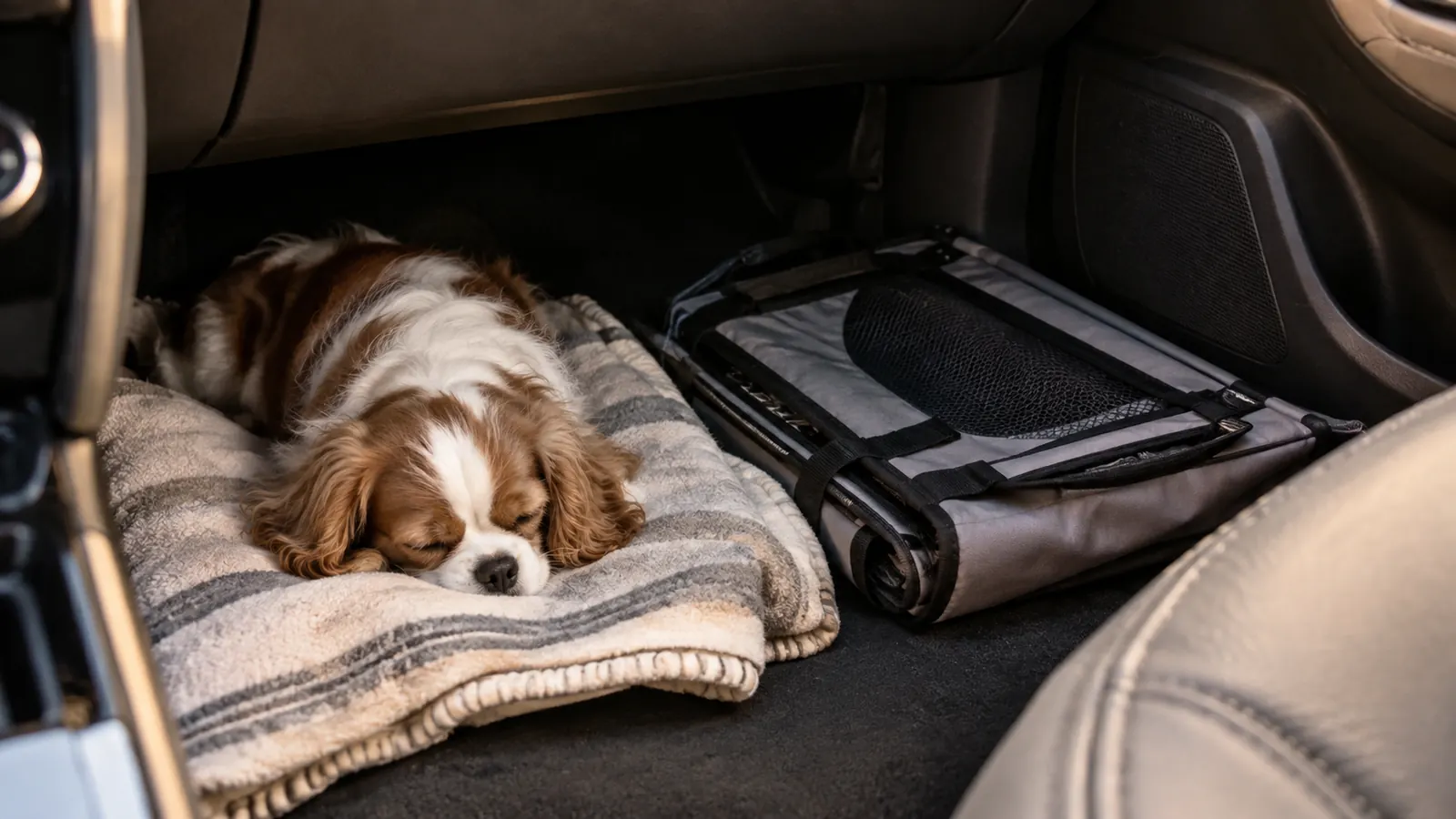
The carrier also folds flat, which matters more than you think. In the CR-V, it slides behind a travel crate in the cargo area. In a hotel room, I set it on the luggage stand and open the top flap, so both dogs can nap where they can smell me. At my sister's house in Colorado Springs, Poppy sleeps in it on the guest room floor. A hard-sided crate would take up the same floor space even when empty. This one takes up nothing when folded.
We make the drive from Round Rock to Colorado at least twice a year. It is a long route through Amarillo, and we spend the night in a motel halfway up. The carrier comes into the motel with us and goes on the floor next to the bed, because Poppy will bounce on it if I set it on the mattress. I thread the seatbelt through the top handle in the CR-V, and it keeps the carrier upright when Biscuit shifts from side to side. If I had to unfold and refold it at every stop, I would not use it. As it is, I leave it set up on the back seat for the whole drive and only fold it when we reach the airport.
The Dimensions That Matter Under a Seat
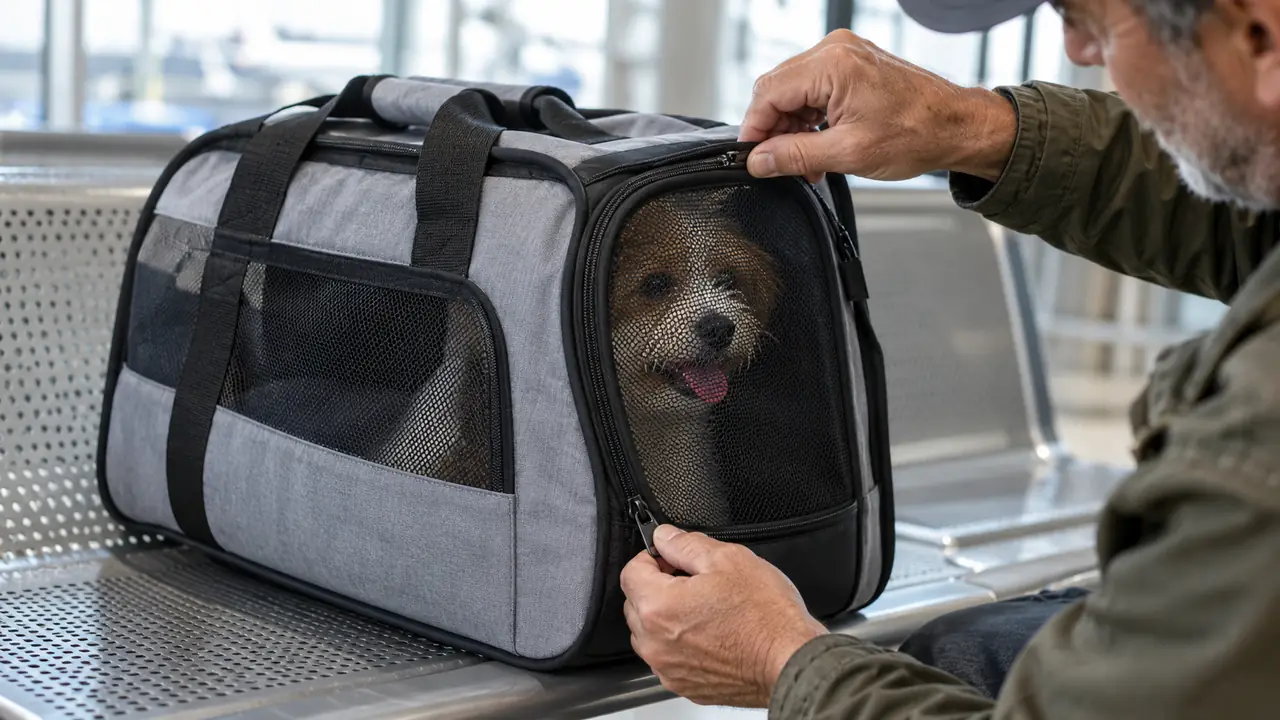
In the spring of 2024, I flew Biscuit from Austin to Denver to visit my brother. I asked at check-in whether the carrier would fit and got a cheerful yes, that is TSA approved. That answer was not enough. I measured the under-seat area of the Delta 737 before boarding. The carrier is roughly 17 inches long, 10.5 inches wide, and 11 inches tall. It went underneath with an inch to spare, but only because I had not stuffed the side pocket with a water bottle. On the return, a Southwest plane had less vertical room, so I rotated the carrier sideways. The dog stays more comfortable when you know which seat you are flying before you pack.
My rule now is simple. I unfold the carrier in the living room and slide it under the passenger seat of the CR-V. If it fits there without bending the top flap, it will fit on most planes. If it does not, I rebook before I pay for the flight. The carrier is flexible enough that it does not need exact measurements, but it does need slack on every side so the top does not press Biscuit's ears.
A neighbor in Round Rock asked why I did not buy a hard-sided carrier for the plane. I told her the seat pocket is not much wider than this soft carrier. Hard cases are heavier and do not flex when the seat angle changes. They also do not fold flat, so at the end of a trip they take up space in the back of the CR-V that I would rather use for a cooler. I keep one hard case at home for the rare vet visit, but this is the one that goes on every trip.
Forty Trips of Wear: What Still Looks New
After forty trips, the side mesh is still clear and the zippers still run smooth. The only real wear is on the bottom pad, which is thinner than I would like for a dog who naps on it for five hours. I replace it with a folded bath mat when we do long driving days. The stitching around the top zipper is starting to show one pulled loop near Biscuit's head, but it has not opened and no seam has split.
The shoulder strap clips are plastic and have held up in heat and cold. The handle is the part I use more than any. I never check this carrier onto a plane, because I have watched baggage carts toss soft bags around. It goes in the overhead bin only when it is empty, and I carry it by the top handle when Biscuit is inside.
I did wash the pad cover once because Poppy had an accident at a gas station in El Paso. I put it in the washing machine on cold, gentle cycle. The cover came out clean but shrank a little and is tight over the foam. I would hand wash next time.
Texas summer heat is the real stress test. The carrier has sat in a parked car for maybe four minutes while I ran back into the house for my sunglasses, and the mesh vents did their job. I never leave a dog in a parked car, but the difference between a ventilated carrier and one with only a few holes is easy to feel. Biscuit's ear stays cool to the touch when the car has been at 78 degrees for half an hour. That is why the mesh panels work better for us than a lined leather carrier would.
One trip to my brother near Denver in October 2024 is the test I remember. We left Round Rock at six in the morning, stopped in Amarillo for lunch, and slept in Raton, New Mexico. The carrier spent eleven hours in the back seat without falling over. In Raton, I noticed the bottom seam had worked loose from the side panel by about half an inch. I pushed it back in and sewed it with a needle and thread in the motel room. It has stayed put for every trip since, and I now check that seam every time I unfold the carrier.
Getting In and Out Without a Wrestling Match
The front opening is wide and folds all the way down. That is the main reason I reach for this carrier instead of the hard-sided one in my closet. Biscuit walks into it on his own. Poppy still tries to lunge out the second the zipper opens, so I unzip only the top flap and lift her out gently.
Inside, the tether clips to a metal ring. I attach it to the back of a harness, never the collar. Poppy can back out of a loose collar in under five seconds. The harness stays on her in the CR-V too, so she is used to the pressure before we leave the driveway.
One afternoon at my vet's office in Round Rock, the woman next to me recognized the carrier and said her cat rides in the same one on Amtrak. We agreed the tether hook is the small detail that makes it feel solid.
The front zipper runs from the bottom around the top, and the pull sits near the top left corner when it is closed. That puts the pull close to Biscuit's head, and more than once he has nudged it with his nose and jiggled it. It has never come open on its own. I still store the carrier with the pull zipped all the way to the stop, not dangling in the middle, so a paw or tail cannot catch it while the carrier is in the back seat.
The Checkpoint Routine I Finally Trust
Going through security used to be my least favorite part of flying with a dog. At Austin-Bergstrom, the carrier goes through the X-ray machine while Biscuit stays on a leash with me. A TSA agent once asked me to take him out and carry him through the metal detector while the empty carrier went on the belt. The carrier folds easily when empty, which made that moment much easier than it could have been.
The side pocket is big enough for my wallet, keys, boarding pass, and one zippered bag of treats. It is not deep enough for a water bottle or a tablet, so I do not use it as my personal item. I carry a separate tote and keep the carrier as light as possible.
On a holiday flight from Austin to Denver, a gate agent asked me to prove the carrier fit under the seat before boarding. I knelt down, slid the Henkelion under the seat in front of an empty row, and zipped it back up. It fit with the same inch to spare. That was the first time in fifteen years of traveling with dogs that a gate agent asked for a demonstration. The carrier is narrow enough that I could show her without fighting the seat frame.
Two Small Dogs, One Carrier: What I Never Do
I also need to be honest about a limit. The carrier is made for one dog up to 15 pounds. I have never put Biscuit and Poppy in it at the same time for travel, even though they weigh twelve pounds together. Two dogs moving around in a soft-sided box make it rock, and a nervous Biscuit makes Poppy bark. They each get their own carrier when we fly, and the second carrier is folded down to the size of a laptop bag when empty.
On the ground, the carrier is not a stroller substitute. It is soft-sided, so I never use the shoulder strap as a way to carry Poppy for more than a few minutes at a time. When she needs a break, the carrier goes on my lap or on the floor. For long airport walks, I bring a separate stroller and use the carrier only as the seat.
Pros and Cons I Noticed
What I Liked
- Folds flat for road trips and the overhead bin
- Front opening is wide enough for Biscuit to walk in
- Tether hook keeps Poppy from lunging while the zipper is open
- Mesh sides let Biscuit see me from the back seat
- Collapses small enough for a second carrier folded in my carry-on
Where It Falls Short
- Bottom pad is too thin for a five-hour drive
- Side pocket is too shallow for a water bottle
- Top zipper curve is starting to show wear after 40 trips
- Soft walls are not for a dog that chews its way out of a carrier
The tether hook has kept Poppy inside every time she has pushed at the mesh. That one detail is why I trust the Henkelion with both of my dogs.
Who This Is For
The Henkelion is for someone who flies a couple of times a year with a small dog and wants one carrier that works from the driveway to the airplane seat. It is for Biscuit-sized dogs that like to look out the mesh, and for dogs like Poppy who know how to push at a zipper. You should buy it if you measure the under-seat area before you book and you are willing to add a real pad under the thin one.
I would not buy the Henkelion for a dog over ten pounds. Biscuit at six pounds has room to turn around, sit up, and rest his chin on the mesh. Poppy at eight pounds is close to the upper end of comfortable for a full day of travel. She can lie flat when the carrier is on the floor, but she cannot stretch out if the seat in front of us is reclined. I plan flights around that by booking a bulkhead row when I can.
Who Should Skip It
Skip the Henkelion if your dog is much over ten pounds. The 15-pound limit is optimistic for a flight, because the dog needs room to turn around, and a plump 12-pound dog will be cramped next to the seat pocket. Skip it if you want a hard-sided carrier for a car ride. Soft walls are easier to store, but they are not for a dog who chews through mesh.
A neighbor wanted to use this for her 14-pound dachshund on a flight to Portland. I told her to test it at home first. Her dog touched four sides and could not turn around easily when the carrier was zipped. She chose a larger hard-sided model instead. The Henkelion works well only when the dog has enough clearance to shift its weight during turbulence. If your dog fills the carrier, the walls press against them and every bump is worse.
Still the first thing that goes in my trunk before a trip
After 40 trips with Biscuit and Poppy, the Henkelion has earned its spot in the CR-V. Measure your seat, add a real pad, and keep the tether clipped. That is the whole system.
Amazon Check Today's Price on Amazon →