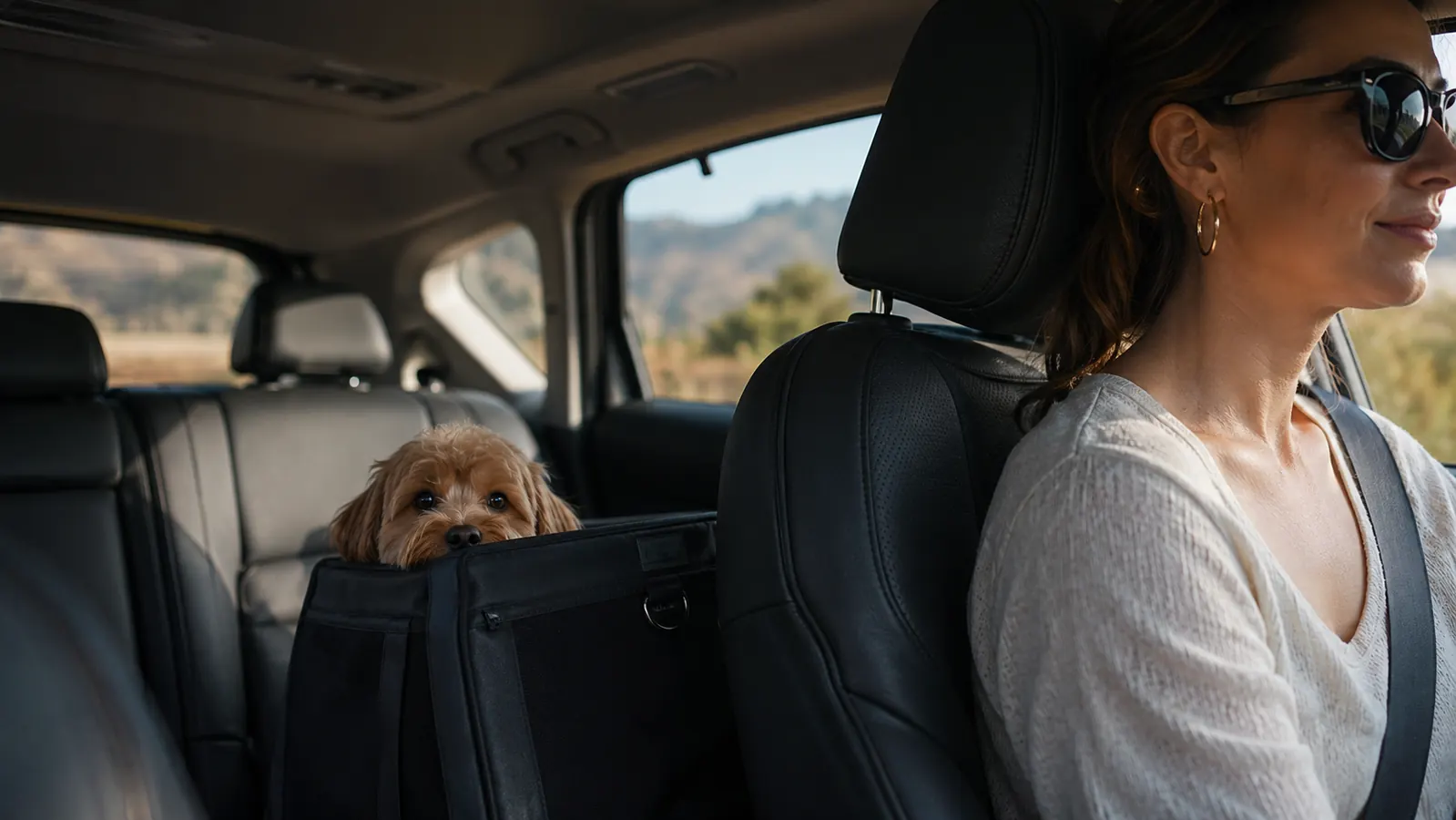
Biscuit has never liked the car. He is a nine-year-old, six-pound Yorkie who starts panting the moment the garage door opens. He paces the back seat in small, frantic circles. He throws up on long drives. Poppy, my other Yorkie, has always been the easy traveler: she settles onto her bed, watches the trucks, and naps. Biscuit needs to see my face in the rearview mirror or he never quite calms down. Over the years I have tried the things most owners try first. A thunder shirt, which he chewed off in twenty minutes. A calming spray that we could never prove did anything. A prescription sedative from our vet that worked so well he slept, but he woke up groggy and miserable, and I did not want that version of a road trip either.
So last winter, when a friend who has shown terriers for close to thirty years told me to try PREMIUM CARE calming chews, I said what I always say, which is that I do not trust pretty bottles. She told me to test it the way I would test anything else: give it on a short drive, repeat it a few times, and see whether the pattern holds. So I bought the 120-count bottle, read the label at my kitchen table, and ran my first trial as a twenty-minute loop to the vet's office and back. That was six months and about forty travel days ago.
The Quick Verdict
These chews did not erase Biscuit's travel anxiety, and I would not trust any chew that claimed to. What they did was consistent and repeatable: they took the edge off, on roughly forty travel days, so a car ride went from crisis to manageable. For a small nervous dog, that is a real result.
Amazon Check Today's Price →The 120-Count Bottle That Has Stayed in Our Travel Bag for Six Months
It is the only calming product still in my routine after six months of real trips, and the honest reason is that the pattern held. If you have an anxious small dog and a trip coming up, that is worth testing on a short drive before you commit to a long one.
Amazon Check Today's Price on Amazon →How I've Used It: Dosage, Timing, and Test Drives
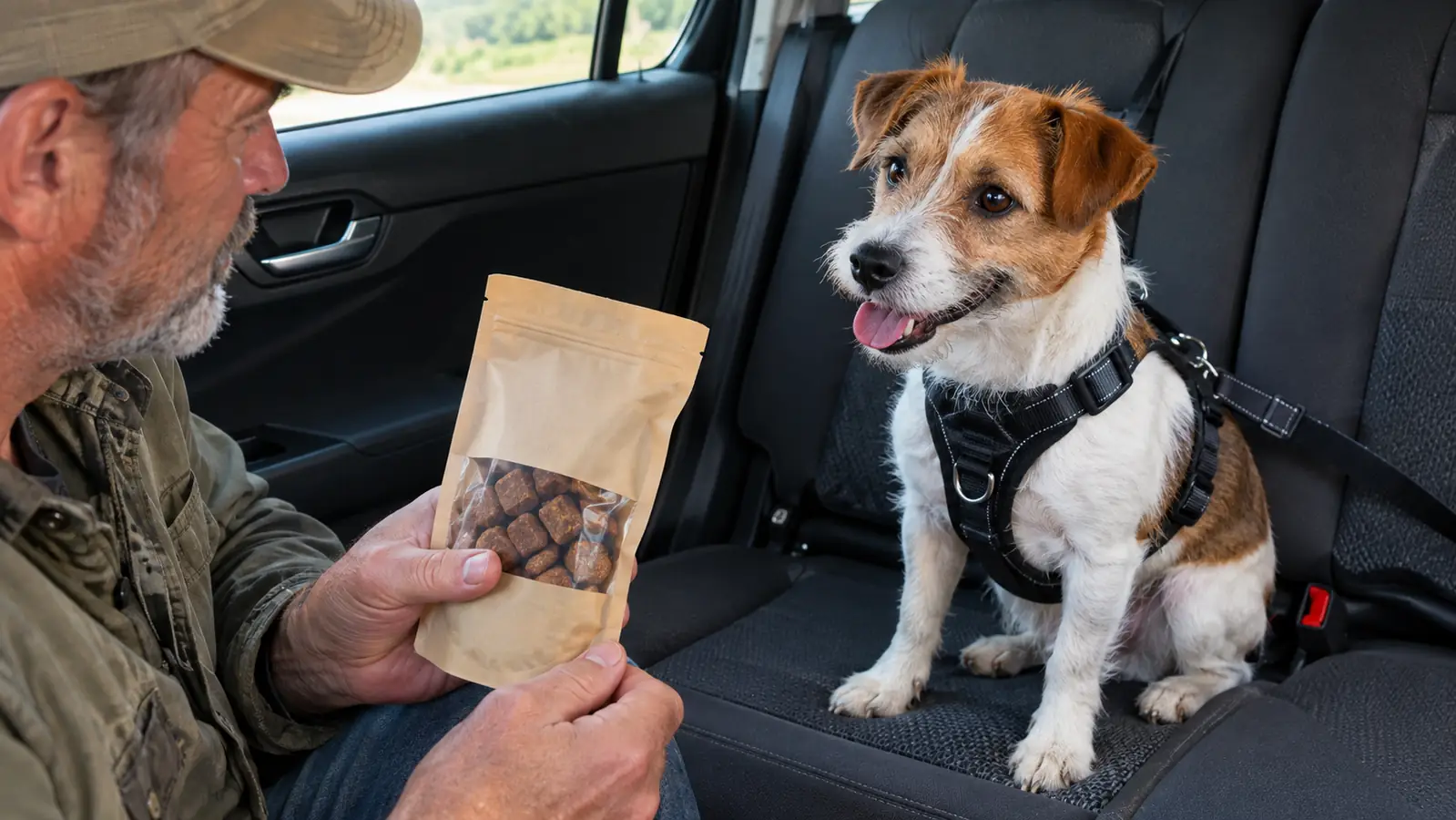
The routine took about a month to settle. On a travel day I gave Biscuit one chew roughly forty-five minutes before we left, following the amount range on the label for a dog his size. Six pounds is a small dose of anything, and I was careful with that. I set a timer on my phone, because the temptation is to give it later and hope, and hope is not a plan. Then I ran a short local loop first, ten or fifteen minutes around Round Rock, so that if the day went badly we were never more than a few minutes from home.
For the first few trials I did not see much. Biscuit still paced, still panted, still threw a worried look over his shoulder. Around the fourth or fifth short drive, the pattern changed. He stopped circling after the first few minutes. He lay down on the back seat with his chin on his paws. He watched the road like Poppy does instead of counting the seconds until the car stopped. I am careful not to overstate it: he did not become a cheerful little tourist. He just became quiet, and quiet from Biscuit in a moving car was new enough that I noticed it every single time.
Once I trusted the pattern on short trips, I tried it on the real ones. The Gulf coast in the spring is a four-hour drive from Round Rock, and he made it without throwing up for the first time in his life. The Colorado trip that summer was two long days in the car, and he slept through most of the first nine hours. On the flights out of Austin that fall, I gave him a chew before we left the house, and he settled in his carrier for the security line instead of trembling through it. That last one mattered to me more than any of the others.
What I Checked Before I Trusted the Bottle
The first thing I did with any calming product is read the back of the bottle like it is a mortgage document, because the front of the bottle is where the marketing lives. I checked what was actually in the chews, and not just the name of the blend on the front. Then I brought the bottle to Biscuit's yearly checkup and asked my vet to look at it with the same eyes she uses for his bloodwork.
Her answer was the honest one I have come to expect from her: products like this are not regulated the way prescription drugs are, and results vary from dog to dog, so my job was to watch Biscuit's behavior instead of believing any promise printed on the label. That advice changed how I tested the chews. It turned me from a hopeful buyer into someone running a small, boring experiment, and the boring experiment is why I trust the result today.
I will also tell you the part that is hard to write. I cannot prove the chew did the work. The routine changed at the same time, and consistency matters to anxious dogs as much as it matters to anxious people. What I can say is that the routine had been consistent before, during the years when every drive ended with a stressed dog and a mess in the back seat. The only new variable was the chew. That is not science. It is enough for me to keep the bottle in the travel bag.
Six Months of Drives and Flights: What Actually Changed
I keep a rough log when I travel with the dogs, because memory flatters and I wanted to be fair to the product. By month three, the difference was not subtle. On the drive back from the Gulf, Biscuit whined for about ten minutes at the start, then settled, which is a shorter settling time than most of our local errands used to give us. On the way to Colorado, he did not throw up at all, and I keep checking that memory because it is still the one that surprises me.
The flight was the clearest test. Airports are Biscuit's worst environment: crowds, noises, a carrier that has to go under the seat in front of me. He has spent takeoffs trembling in past years. This time, with a chew about an hour before we left the house, he curled up in the carrier and slept from the gate to the descent. The woman next to me asked if he always traveled that well. I told her no, and that the answer was complicated, and that we had practiced for six months to make it look easy.
The honest summary of six months is this: Biscuit is still an anxious little dog. He still does not love the car. On a bad day, when the traffic is rough or a storm is building, he still paces. The difference is that the bad days are now the exception instead of the rule, and the crash takes minutes instead of hours. For a nine-year-old dog with four years of bad car memories behind him, that is meaningful progress.
The Honest Cons Nobody Puts on a Label
The biggest con is the one you will not read in any listing: it will not work for every dog, and there is no way to know which kind you have without a trial. My friend's terrier chews them happily and still paces. My Biscuit, who is the anxious one, settled. I have read enough reviews to know that plenty of owners saw no change at all, and I believe them, because supplements behave differently in different bodies than drugs do, and even drugs do not work for everyone.
It also will not rescue you in the middle of a panic. Timing is the whole job. The chew needs about forty-five minutes to do whatever it does, and if you give it after Biscuit has already started pacing and panting at the sight of the highway, you have missed the window. I learned this the afternoon a hailstorm rolled in while we were on I-35. Biscuit was beside himself, the chew was in his bowl at home, and nothing I could have given him in that moment would have worked fast enough.
And it is not a replacement for the boring work. The calm rides came from pairing the chew with short practice drives, a consistent routine, and a dog who slowly built better memories of the car. If you skip the practice and rely only on the product, you will probably be disappointed. The chew was one tool in a box that also included patience, a timer, and a lot of short loops around Round Rock.
Why PREMIUM CARE's 120-Count Bottle Earned Its Place in Our Travel Bag
Because Biscuit only needs a chew on travel days, the bottle has lasted us the whole six months with plenty left. One small dog, used only when we actually leave town, does not burn through a 120-count bottle quickly, which matters when you are comparing one calming product against another and thinking about value over time. I have used roughly forty chews in six months, and every one of those forty days was a day the pattern held.
The part I did not expect is that we need it less now. Somewhere around month four, Biscuit started handling short local drives without any chew at all. I still use one before highways and flights, but the local errands have gotten easier, and I credit the six months of consistent, calm practice more than I credit any single ingredient. If you had told me last winter that we would do a two-day drive with a quiet Yorkie in the back seat, I would have laughed. It happened anyway.
What I Liked
- On roughly forty travel days over six months, the pattern held: Biscuit settled faster and stayed calm longer
- Timing was predictable: about forty-five minutes before departure, no guessing
- He stayed alert and himself, with none of the heavy grogginess we saw with a prescription sedative
- It paired well with short practice drives instead of pretending to replace them
- The 120-count bottle lasted a small travel-day dog most of the year
Where It Falls Short
- Did nothing noticeable during a sudden hailstorm panic, because it needs to be given well before the meltdown
- Works for some dogs and not others, and you cannot know which until you test it
- Needs forty-five minutes of lead time, so it cannot rescue an already anxious dog at the moment of panic
- Texture and taste may not suit a picky eater; Biscuit needed his tucked into a bit of boiled chicken at first
- It is a supplement with real limits, not a fix for a sound phobia or deep separation anxiety
On the Colorado drive, Biscuit slept from the Texas line to the outskirts of Round Rock. In nine years of car rides, that had simply never happened before.
Who This Is For
If you have a small dog who handles the car poorly but does not live in a state of constant fear, and you are willing to test a product honestly a few times before trusting it, PREMIUM CARE's chews are a reasonable thing to try. They suit owners who can plan ahead, because the timing is the whole trick. They also suit owners who understand that a chew is a tool in a training plan, not a substitute for one. Travel dogs with mild situational anxiety are exactly the profile this worked for, and if that is your dog, a short test drive is a low-risk way to find out.
One more note on fit: if your dog is a puppy, or if the anxiety began after a specific event like an accident or a rescue history, talk to your vet before you add anything. Calming chews can be a gentle option, but they are not a substitute for figuring out what your dog is afraid of in the first place.
Who Should Skip It
Skip these if your dog's anxiety is severe enough that your vet has recommended a behaviorist, or if your dog is already on daily medication and you have not talked to your vet about adding anything new. Also skip them if you need an on-the-spot rescue, because timing is the whole mechanism and there is no version of these that works in the middle of a panic. And if you have a picky eater who turns up his nose at new textures, buy the smallest count you can find and test the taste before you commit to a big bottle. I watched a friend's terrier refuse these flat-out, which is a useful reminder that dogs vote with their mouths.
And the hardest skip of all: if you are imagining a dog who calmly rides in the car without any work on your part, this is not that. No chew is that. The ones that seem to promise that in a listing are the ones I would distrust the most.
A Six-Month Test Run, and the Pattern Held
Every trip in our routine has been smoother since Biscuit started on these, from four-hour Gulf runs to two-day Colorado drives. If you have an anxious small dog and a trip coming up, run your own honest trial on a short loop before the long one. That is exactly how we came to trust them.
Amazon Check Today's Price on Amazon →